
Opening thoughts
A work of art is not just an object on a wall. Under U.S. tax law, it is generally treated as property, which means decisions about whether to hold it, gift it, donate it, bequeath it, or sell it can affect income tax, capital gains tax, estate planning, and family wealth transfer.
For many collectors, the real question is not whether art can be a “write-off.” The more useful question is how art fits into a larger plan for stewardship: preserving a collection, documenting it properly, insuring it, deciding who should inherit it, and determining whether certain works belong in the family, in an archive, or in an institution.
That is why art planning is not only for billionaires. A modest collection can still create difficult choices around valuation, gifting, family dynamics, charitable intent, and cultural memory, while a major collection raises those same issues at a different scale and with more tax complexity.
Art Is Treated as Property Under U.S. Tax Law
Artwork is generally treated as property for federal tax purposes, not as a special category with its own standalone code section. In practice, art planning usually draws on a cluster of rules: charitable contribution rules under IRC Section 170, capital gains rules for collectibles under Sections 1(h), 1221, and 1222, and estate and gift tax rules that govern what happens when art is transferred during life or at death.
For collectors, art is usually a capital asset and also a collectible. That matters because long-term gains on collectibles can be taxed at a federal rate of up to 28 percent, which is higher than the usual long-term capital gains rate that applies to many other assets.
Art also becomes part of the estate at death and is generally included at fair market value for estate tax purposes. At the same time, inherited artwork typically receives a step-up in basis to date-of-death value, which can reduce or eliminate prior capital gains if heirs sell the work after inheritance.
This framework is why art often sits at the intersection of tax planning and legacy planning. The tax code does not only ask what a work is worth; it also asks when it was acquired, how long it was held, whether it appreciated, how it is being transferred, and who receives it.
Why Some Collectors Donate Instead of Sell
One reason collectors donate appreciated art instead of selling it is that a direct donation can avoid capital gains tax on the appreciation while also creating a charitable deduction, assuming the legal requirements are met. That combination is often more efficient than selling the work, paying tax on the gain, and then donating the remaining cash.
For example, a collector who bought a work at a relatively low cost and now holds a much more valuable piece may face a large tax bill if the work is sold. If that same work is donated directly to a qualified public charity, such as a museum or university collection, the donor may avoid recognizing the built-in gain and may be eligible for a deduction tied to fair market value, subject to adjusted gross income limits and substantiation requirements.
This is attractive for high-net-worth collectors because the appreciation on major works can be enormous and the donor may also be in a high marginal income tax bracket. But the principle is not limited to wealthy families; even a collector with a smaller but appreciated work can benefit from understanding when a donation is more tax-efficient than a sale.
The deeper point is that donating art can express values as much as it reduces taxes. A family may prefer to see a work placed in a museum, university, archive, or community institution rather than liquidated, particularly if the piece has cultural, educational, or intergenerational importance.
Not All Donations Work the Same Way
The tax result for a donation depends on more than the value of the artwork. It also depends on what type of charity receives it, how long the donor held it, whether the donor is the artist or a collector, whether the charity's use is related to its mission, and whether the donor has met the appraisal and reporting requirements.
One of the most important distinctions is the related-use rule. When art is donated to a qualified charity and the charity uses it in a manner related to its exempt purpose, such as a museum keeping and displaying the work, the donor may be able to deduct fair market value. If the charity's use is unrelated, or if the structure falls into a less favorable category, the deduction may be limited to basis instead.
Another important distinction is between the artist and the collector. A collector who donates appreciated art may be eligible for a fair-market-value deduction in the right circumstances, while an artist who donates their own work is generally limited to the cost of materials rather than the artwork's market value.
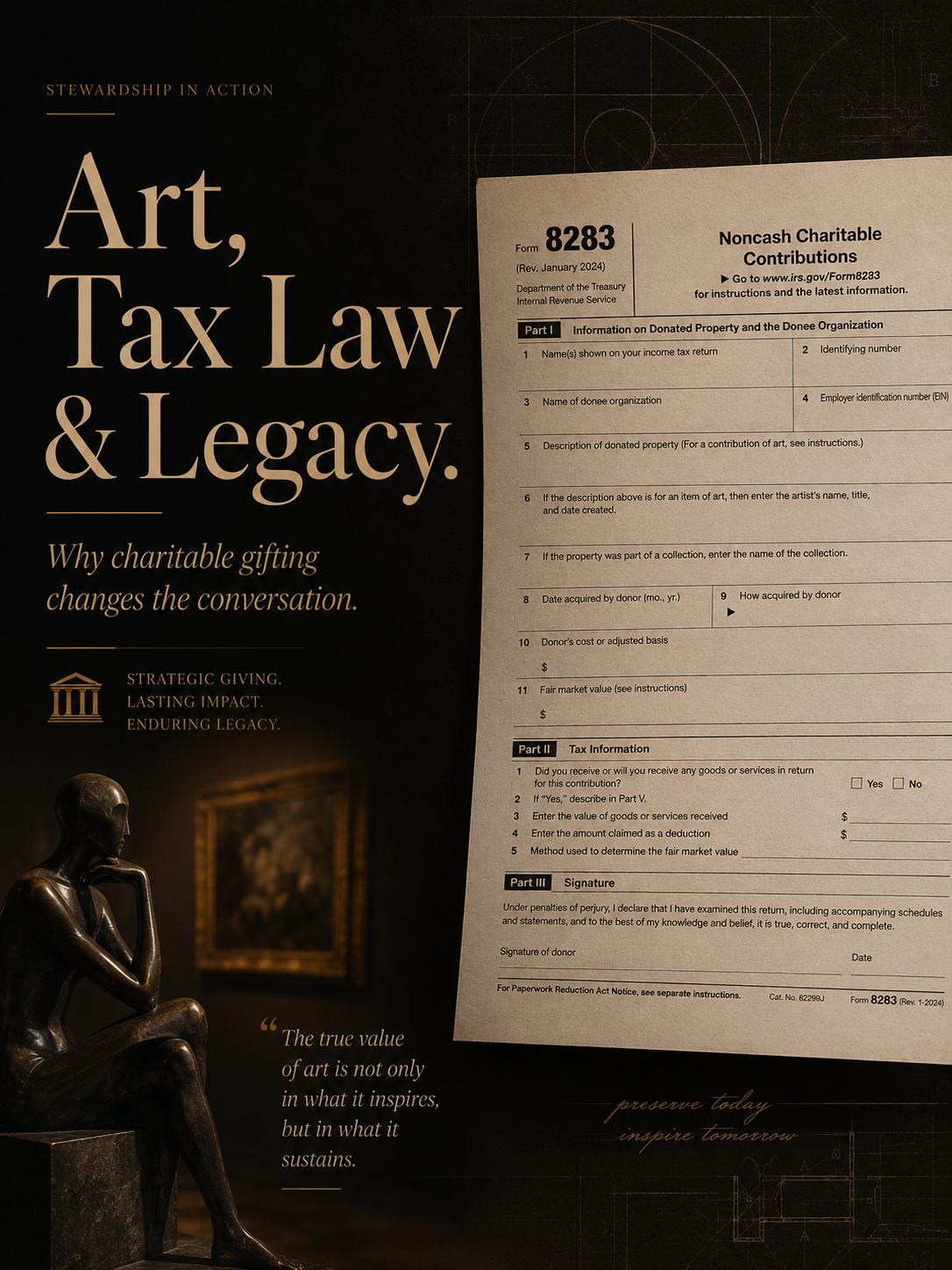
Documentation is also central. The IRS requires qualified appraisals, completed forms, and proper recordkeeping for larger noncash charitable gifts, and art donations have historically received close scrutiny when values are high or documentation is weak.
Stewardship Changes the Conversation
Thinking about art only as an investment narrows the real work of collecting. Stewardship widens the lens to include preservation, insurance, condition, provenance, archives, family communication, and the long-term future of the work itself.
This is not about flipping art. It is about understanding preservation, insurance, gifting, succession, archives, institutions, family dynamics, and cultural memory as parts of one larger conversation about responsibility.
For a normal collector, stewardship may mean building a clean inventory, keeping purchase records, maintaining insurance schedules, documenting provenance, and deciding whether heirs actually want the work. For a high-net-worth family, stewardship may expand into collection management systems, formal archives, art-specific insurance reviews, professional appraisals, governance through trusts or entities, and conversations with museums or other institutions about long-term placement.
Stewardship also changes the emotional tone of legacy planning. Instead of asking only, “How do taxes work on this piece?” the better question becomes, “What should happen to this work so its financial, personal, and cultural value is handled well?”
Why this matters to any collector
Any collector can benefit from thinking about art in legacy terms because art often carries emotional, financial, and cultural value at the same time. Even when a collection is not large enough to create a federal estate tax issue, it can still create confusion over valuation, disputes over who should inherit what, gaps in insurance, or the loss of important records and provenance.
Legacy planning gives collectors a chance to make those decisions deliberately rather than leaving them to heirs under stress. It can clarify whether specific works should stay in the family, be sold, be gifted during life, be donated to an institution, or be used to support a philanthropic goal.
What collectors can do now
Build a current inventory of the collection, including artist, title, dimensions, medium, purchase date, purchase price, and any supporting provenance or condition information.
Review insurance coverage and make sure insured values are not stale, especially if certain works have appreciated materially.
Identify which works matter most financially, emotionally, and culturally, since those three categories are not always the same.
Obtain updated appraisals for significant works when planning gifts, charitable donations, trust transfers, or broader estate planning conversations.
Talk with family members about interest, responsibility, and expectations so the collection does not become a source of confusion or conflict later.
Coordinate the art plan with a tax professional and estate attorney so wills, trusts, charitable intentions, and documentation all align.
For an average collector, those steps may be enough to make the collection easier to manage and easier to pass on. For a high-net-worth collector, the same foundation supports more advanced planning involving trusts, charitable structures, and succession across generations.
Questions Worth Asking Your Tax Professional
Is this artwork currently personal-use property, an investment asset, or part of a business context under the tax rules that apply to this collector?
If this work were sold, what federal and state taxes could apply to the gain, including the collectibles rate?
If this work were donated instead of sold, would the likely deduction be based on fair market value or cost basis, and why?
Does the intended recipient qualify as a charity for the most favorable treatment, and would its use likely satisfy the related-use rule?
What appraisal and substantiation steps are required before a planned gift or donation is completed?
Would it be smarter to gift this work during life, hold it until death for a step-up in basis, or transfer it through a trust or other vehicle?
If heirs inherit the work, what basis will they receive and what tax exposure would they face if they sell it later?
Does this collection create estate-tax exposure, liquidity concerns, or family governance issues that should be addressed now?
Should certain works be earmarked for charitable giving, institutional placement, or family inheritance based on both tax and stewardship goals?
How should appraisals, insurance values, and estate documents be updated over time as the collection changes?
Sources:
IRS Topic 506 — Charitable Contributions
Topic: Qualified charitable gifts and deduction rules for donations.
Link: IRS Topic 506
IRS Publication 526 — Charitable Contributions
Topic: Core rules for charitable deductions, including donated property.
Link: IRS Publication 526IRS Form 8283 — Noncash Charitable Contributions
Topic: Reporting rules for noncash gifts, including art.
Link: Form 8283Internal Revenue Code §170
Topic: Charitable contribution deductions, including donated artwork.
Note: This is the main tax code section for deductions on charitable gifts of property. IRS FormInternal Revenue Code §§1221 and 1(h)
Topic: Collectible capital gains treatment.
Note: Art is generally treated as a collectible for capital gains purposes. Cornell LawInternal Revenue Code §§2001, 2010, 2031, 2501
Topic: Estate and gift tax rules and valuation.
Note: Relevant to how art is handled in legacy and succession planning. Cornell LawGMU Law Review article on artists and art donations
Topic: How §170 applies to self-created art and donated artwork.
Link: GMU Law ReviewWealthspire — Tax and Estate Planning for Artists and Art Collectors
Topic: Practical planning ideas for collectors, gifting, and trusts.
Link: Wealthspire article