
Opening Thoughts…
Collectors often spend years deciding what to acquire, how to live with it, and what it means within the shape of a life. Far fewer spend the same energy deciding what should happen to that work later, even though estate planning sources consistently note that art can become one of the most complicated assets to transfer because it carries emotional value, financial value, and stewardship obligations at the same time.
That is why one of the most important parts of legacy planning is not only legal paperwork. It is conversation. Before a collection is handed down, promised to a museum, or folded into an estate, collectors need honest discussions with heirs and realistic conversations with institutions about interest, capacity, responsibility, and fit.
Why these conversations matter
Art does not behave like a brokerage account or a checking account. A collection can require storage, insurance, conservation, transport, appraisals, recordkeeping, and judgment about whether a work should be kept, sold, donated, or shared across a family.
When those decisions are not addressed during life, families can be left with confusion over value, disputes over who should inherit what, uncertainty about whether a museum will even accept a promised gift, and the loss of key records that establish provenance or condition.
Having the conversation early does not eliminate complexity, but it does change its tone. It moves the collection from being a surprise problem for heirs into a deliberate part of a family’s financial and cultural planning.
The first conversation: Do the heirs actually want the art?
Many collectors assume that children or relatives will naturally value a collection because they grew up around it. Estate planning guidance for art collectors suggests that assumption can be dangerous, because heirs may admire the work emotionally while having little interest in maintaining, insuring, storing, or managing it.
A useful conversation starts with simple but serious questions. Which pieces feel meaningful enough to keep? Which would feel like a burden? Which works would an heir be comfortable living with, caring for, or eventually selling?
This is not just about preference; it is about capacity. An heir who appreciates a collection may still be the wrong steward if they do not have the space, liquidity, or desire to maintain it properly.
The second conversation: Who is the steward and who is the seller?
In many families, not everyone will relate to art in the same way. One heir may want to preserve a collection intact, while another may view sale as the most practical option. Planning sources emphasize the importance of identifying those differences early because they affect how a collection should be divided, whether a trust makes sense, and whether liquidity planning is needed to keep decisions from turning adversarial.
This conversation helps separate emotional attachment from long-term responsibility. It allows a collector to see whether a collection should remain concentrated with one steward, be divided by category or value, or be partially sold so that inheritance feels equitable rather than symbolic.
In some cases, this is also where the idea of an art executor or designated advisor becomes useful. Several estate-planning discussions in the art field note that families may need a person with subject-matter knowledge to help manage valuation, logistics, and communication after death.
The third conversation: What records, stories, and instructions need to be shared?
A collection without documentation becomes harder to value, harder to insure, and harder to place well. Guidance for collectors repeatedly stresses the importance of keeping invoices, appraisals, provenance files, exhibition history, condition reports, and insurance information in a way heirs can actually find and understand.
But records are only part of the picture. Collectors should also communicate why certain works matter, how they were acquired, what relationships surround them, and whether there are cultural or family reasons a particular piece should remain together with another.
This is where legacy becomes more than price. The story around a work can shape whether heirs preserve it, whether a donor file is compelling to an institution, and whether a future sale feels like an informed choice rather than a rushed liquidation.
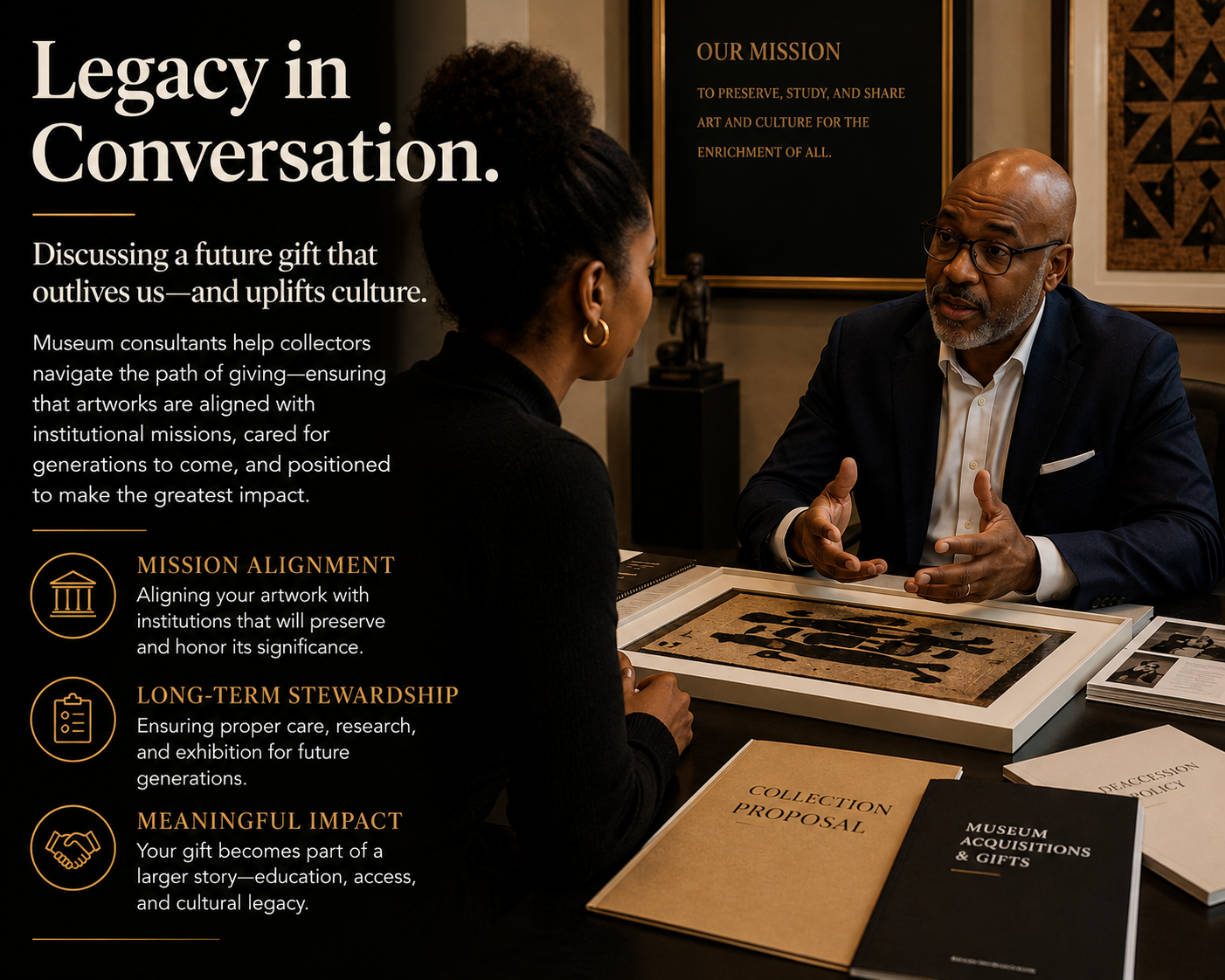
The fourth conversation: Will an institution actually want the work?
Collectors sometimes assume that a museum, university, archive, or nonprofit will be honored to receive a bequest. In practice, institutions are selective, and estate-planning guidance for collectors recommends discussing possible gifts in advance rather than relying on assumptions made in a will.
Institutions evaluate whether a work fits their mission, curatorial priorities, storage capacity, conservation resources, and collecting strategy. A piece may be significant to a family but still fall outside the collecting scope of a museum or be more appropriate for a university gallery, local archive, or community-based organization.
This is one of the most useful reality checks in legacy planning. An early conversation can prevent a collector from structuring a gift around an institution that was never likely to accept it and can redirect the work toward a setting where it will be better understood and used.
The fifth conversation: What does the institution expect, and what does the family expect?
Even when an institution is interested, expectations need to be clarified. A collector may imagine permanent display, naming recognition, or a promise that the work will never be sold, while the institution may reserve discretion over exhibition schedules, storage, conservation treatment, and deaccession policies.
Clear communication matters because donor expectations and institutional realities do not always align. If a gift is meant to serve both tax planning and cultural stewardship, those goals need to be translated into realistic terms before legal documents are finalized.
This is also where heirs should understand the intention behind a planned gift. When family members know why a work is meant for a museum or archive rather than private inheritance, it can reduce confusion and resentment later.
What changes for a normal collector versus a high-net-worth family
The core questions are the same at every level: who wants the work, who can care for it, what should be sold, what should be donated, and what story should survive alongside the objects. What changes is the scale of consequence.
For a normal collector, these conversations may prevent avoidable conflict, help heirs decide what to keep, and make sure insurance, inventory, and basic estate documents are in order. For a high-net-worth family, the same conversations often sit inside a more complex framework of appraisals, trusts, charitable planning, liquidity needs, and coordinated relationships with advisors and institutions.
The practical lesson is that legacy planning does not begin when a collection becomes famous or institutionally important. It begins when a collector decides that the future of the work matters as much as the acquisition of it.
Questions collectors can ask heirs
Which works feel personally meaningful, and which do not?
If you inherited this group of works, would you want to keep them, share them, or sell them?
Do you have the space, resources, and desire to care for these works properly?
Would you want help from an advisor, appraiser, or art executor in managing the collection?
Are there works you believe should stay together because of family history or cultural significance?
Questions collectors can ask institutions
Does this work fit your mission and collecting priorities?
Would you realistically accession, exhibit, study, or archive the work?
Are there conservation, storage, or logistical issues that would affect your interest?
If a gift were made, what expectations should remain flexible and what could be documented clearly?
Are there other institutions or organizations that may be a better fit for this material?
Ownership to Stewardship Starts Now
The strongest art legacy plans are not built only through tax strategy or estate documents. They are built through conversations that surface truth early: whether heirs want the work, whether institutions can responsibly receive it, and whether the collector has documented both the objects and the intentions around them.
For collectors, this is one of the clearest shifts from ownership to stewardship. The work is no longer only about personal taste or market value; it becomes part of a broader decision about family memory, public access, and the long life of culture beyond one household.
Sources:
• Northwestern Mutual - 6 Ways to Start Investing in Art
https://www.northwesternmutual.com/life-and-money/6-simple-steps-to-start-investing-in-art/
• Bank of America Private Bank – Estate Planning for Art Collectors: What to Consider
https://www.privatebank.bankofamerica.com/articles/art-and-your-estate-plan.html
• Artwork Archive – How To Create an Estate Plan for Your Art Collection
https://www.artworkarchive.com/blog/how-to-create-an-estate-plan-for-your-art-collection
• Artwork Archive – Art Executors and Estate Planning for Art Collectors
https://www.artworkarchive.com/blog/art-executors-and-estate-planning-for-art-collectors
• Miller Kaplan – An Art Collection is a Special Asset to Account for in an Estate Plan
• Hailey-Petty Law – Estate Planning Tips for Art Collection Inheritance
https://haileypettylaw.com/estate-planning-tips-for-art-collection-inheritance/
• Alatsas Law Firm – Estate Planning for Art Collectors
https://www.alatsaslawfirm.com/blog/estate-planning-for-art-collectors.cfm
• Offit Kurman – Not Discussing Collections with Heirs
https://www.offitkurman.com/offit-kurman-blogs/not-discussing-collections-with-heirs